On this page
Intermittent fasting gets talked about like it is some extreme discipline reserved for the ultra-committed. It is not. At its heart it is just choosing when you eat rather than obsessing over every single thing you eat. For a lot of people that shift alone makes eating simpler and more mindful.
If you are curious but a little nervous, this guide walks through the basics in plain language, so you can decide whether it fits your life and start without overthinking it.
What Intermittent Fasting Actually Is
Intermittent fasting, often shortened to IF, is an eating pattern that cycles between periods of eating and periods of not eating. You are not changing what is on your plate, at least not at first. You are changing the window of hours during which you eat.
For most of human history we did not graze from morning to midnight. Food came in windows, and our bodies handled it fine. IF is a modern, structured way of returning to something closer to that rhythm.
During the fasting window your body finishes digesting, insulin settles down, and it starts drawing on stored energy. During the eating window you refuel normally. That is the whole concept.
A quick but important note: fasting is not right for everyone. If you are pregnant, breastfeeding, have diabetes, a history of disordered eating, or any medical condition, talk to your doctor before starting.
The Popular Schedules
The beauty of IF is that there is no single correct version. You pick the fasting-to-eating ratio that fits your day.
16:8 — the classic
You fast for 16 hours and eat within an 8-hour window. In practice that often means skipping breakfast, eating your first meal around noon, and finishing dinner by 8 PM. Sleep covers a big chunk of the fast, which makes it more manageable than it sounds.
14:10 — the gentle entry point
Fast for 14 hours, eat within 10. This is the friendliest place for beginners. A 14-hour fast might mean finishing dinner at 8 PM and eating again at 10 AM. Barely disruptive, and a great way to test the waters.
12:12 — training wheels
An even split. Twelve hours fasting, twelve eating. Honestly, plenty of people already do something close to this without calling it fasting. It is a fine first step if 14:10 feels like a stretch.
Here is how the common approaches compare:
| Schedule | Fast | Eating window | Best for |
|---|---|---|---|
| 12:12 | 12 hours | 12 hours | Absolute beginners |
| 14:10 | 14 hours | 10 hours | Easing in comfortably |
| 16:8 | 16 hours | 8 hours | Once you are adjusted |
Start at the top of that table and only move down when the current level feels easy.
How to Start Gently
The mistake beginners make is jumping straight to a long fast, feeling miserable, and quitting by day two. Do the opposite. Ease in.
Push breakfast back slowly
If you normally eat at 7 AM, move it to 8, then 9, then 10 over a couple of weeks. Your hunger signals adjust, and the change barely registers.
Pick a window that fits your life
If you love a big family breakfast, fast in the evening instead and eat earlier in the day. There is no rule that says the eating window has to be at any particular time. Build it around your real schedule.
Stay busy in the morning
Hunger comes in waves and passes. A morning full of work or a walk moves you past the wave far better than sitting around thinking about food.
Be patient with the first week
The first few days can feel odd as your body adjusts. That usually settles within a week or two. If you feel genuinely unwell, dizzy, or shaky, stop and eat something.
What Breaks a Fast
This trips up a lot of newcomers. The general rule: anything with meaningful calories breaks a fast. Anything essentially calorie-free does not.
Safe during your fast:
- Water, still or sparkling
- Black coffee, no sugar or milk
- Plain tea, unsweetened
Breaks your fast:
- Anything with sugar
- Milk, cream, or plant milks in your coffee
- Snacks, bites, "just a little something"
- Most flavored or sweetened drinks
When in doubt, if it has calories, it counts. Keep the fasting window clean and it works far better.
Where an App Helps
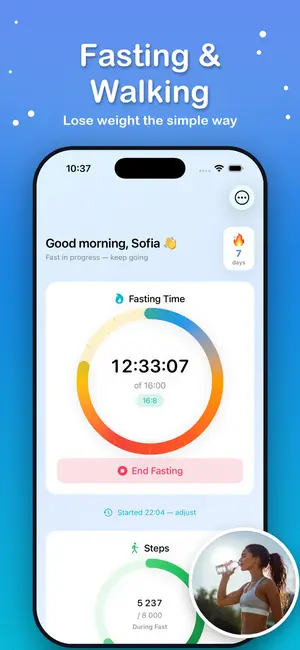
Tracking the hours in your head gets old fast, and this is where a tool earns its place. Fasting and Walking makes it dead simple to run a fast without watching the clock. You set your window, the app tracks your fasting hours, and it pairs your fasting with walking so your daily movement supports the whole effort. It takes the mental load off so you can just live your day.
Download Fasting and Walking Free →
Learn more about how it works: Fasting and Walking.
Simple Tips for Success
- Hydrate hard. A lot of what feels like hunger is actually thirst. Keep water flowing through your fasting window.
- Do not binge when the window opens. Eat normal, balanced meals. Fasting then stuffing yourself defeats the purpose.
- Prioritize protein and whole foods during your eating window so you stay full and nourished.
- Sleep well. Poor sleep spikes hunger hormones and makes fasting genuinely harder.
- Be flexible. Miss a day, have an event, life happens. IF is a long-term pattern, not a pass-fail test.
The Bottom Line
Intermittent fasting is one of the simplest eating patterns to try because you are not counting calories or banning foods. You are just choosing your hours. Start with 14:10, ease in over a couple of weeks, keep your fasting window clean, and stay hydrated.
Give it a fair month before you judge it. And if you have any health condition, get your doctor's blessing first. Done gently and patiently, it can become a sustainable rhythm rather than a grind.
Written by PG App Studios
An independent app studio in the Algarve run by Pedro Gregório. We write about the problems our apps solve, from learning European Portuguese to raising a toddler.