
On this page
People often ask whether European and Brazilian Portuguese are really that different. They are the same language, yes, and speakers understand each other. But the gap is wider than most beginners expect, roughly comparable to British and American English, and in some ways larger. If you are heading to Portugal, picking the right variety from the start saves you real confusion. Here is what actually differs and why it matters.
Pronunciation: The Biggest Divide
The clearest difference is how the two varieties sound, and it is significant enough that beginners trained on one can struggle to follow the other.
- Vowel reduction. European Portuguese swallows unstressed vowels. A word like "pequeno" can sound compressed, almost clipped, while Brazilian Portuguese pronounces vowels more fully and openly.
- The final and pre-consonant s. In Portugal, an s at the end of a word or before certain consonants is often pronounced like the English sh. "Portugues" ends with a soft sh sound. In most of Brazil it stays as a clear s.
- Rhythm. Brazilian Portuguese is often described as more musical and open, with a sing-song flow. European Portuguese is more closed and consonant-heavy, which is why newcomers say it sounds faster and harder to catch.
- The letter t and d. Before an i or e sound, many Brazilian speakers palatalize these, so "dia" sounds like "jia" and "tia" like "chia." European Portuguese keeps the hard t and d.
For a beginner, this means listening practice must match your target variety. Train your ear on the accent you will actually hear.
Vocabulary: Everyday Words That Change
Plenty of daily words differ entirely. If you learn the Brazilian term, you may not be understood in a Lisbon shop, and vice versa. Here are common examples where the two split.
| English | European Portuguese | Brazilian Portuguese |
|---|---|---|
| bathroom | casa de banho | banheiro |
| train | comboio | trem |
| bus | autocarro | onibus |
| mobile phone | telemovel | celular |
| ice cream | gelado | sorvete |
| breakfast | pequeno-almoco | cafe da manha |
| you (informal) | tu | voce |
| suit | fato | terno |
Notice that some of these are not just accent differences but completely different words. A Portuguese speaker asking for the "casa de banho" would puzzle nobody in Portugal, but "banheiro" in Portugal actually refers to a lifeguard. These mismatches are exactly why variety matters.
Grammar: Subtle but Real
The grammar differences are quieter than pronunciation but they shape how natural you sound.
Tu versus voce
In Portugal, "tu" is the everyday informal you, used with friends, family, and peers, and it comes with its own verb conjugations you must learn. "Voce" exists but is more formal or regional. In most of Brazil, "voce" is the default informal you and "tu" is rare or used without its proper conjugation. If you learn Brazilian Portuguese, you will likely skip the tu forms entirely, which leaves a real gap for Portugal.
The present continuous
This one trips people up constantly. To say "I am doing," the two varieties build the sentence differently:
- European Portuguese uses estar plus a plus the infinitive: "estou a fazer."
- Brazilian Portuguese uses estar plus the gerund: "estou fazendo."
Both are correct in their own variety, but using the wrong one immediately marks you as trained in the other. For Portugal, the a plus infinitive pattern is what you want.
Pronoun placement
European Portuguese often attaches object pronouns to the end of the verb, as in "chamo-me," while Brazilian Portuguese tends to place them before, as in "me chamo." This is a small thing that natives notice instantly.
Which Should You Learn?
The answer is simple: learn the variety of the place you are going. If your life, travel, residency, or citizenship plans point to Portugal, learn European Portuguese. If you are Brazil-bound, learn Brazilian. Do not let the abundance of Brazilian material online push you into the wrong one just because it is easier to find.
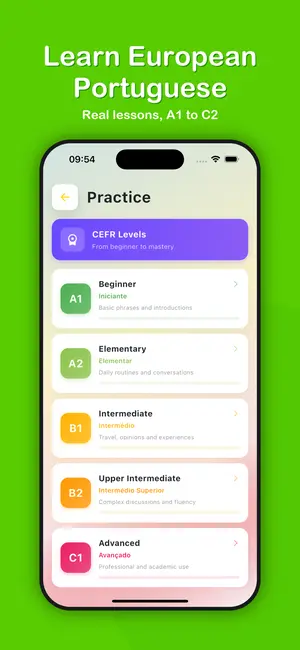
This is the exact problem Portugal Lifestyle Pro was built to solve. The most downloaded language app on the planet does not even offer European Portuguese, so learners headed to Portugal are funneled toward Brazilian content by default. Portugal Lifestyle Pro teaches the Portugal variety specifically, with the vocabulary, the tu conjugations, the estar a fazer construction, and the closed European accent you will actually encounter. You can see how it is structured on our Portugal Lifestyle Pro page.
Download Portugal Lifestyle Pro Free →
The Bottom Line
European and Brazilian Portuguese are two branches of one rich language. Neither is better. But they are different enough that mixing them up causes real friction, in pronunciation, vocabulary, and grammar. Choose the branch that matches your destination, train your ear on that accent, and learn the words people around you will actually use. For Portugal, that means committing to the European variety from day one, and everything gets easier from there.
Written by PG App Studios
An independent app studio in the Algarve run by Pedro Gregório. We write about the problems our apps solve, from learning European Portuguese to raising a toddler.