
On this page
You do not need to be fluent to travel well in Portugal. A handful of phrases, said with a little effort, changes how people treat you. Locals genuinely appreciate visitors who try, even imperfectly. This guide gives you fifty practical European Portuguese phrases, grouped by the situations you will actually face, with the English meaning and a note on the sounds that trip people up.
A quick note before we start: these are the Portugal versions, not Brazilian. The vocabulary and accent differ, and using the local words earns instant goodwill.
Greetings and Basics
Start every interaction with a greeting. It is expected, and skipping it reads as rude.
- Ola means hello. Simple and works any time.
- Bom dia means good morning, used until around midday.
- Boa tarde means good afternoon.
- Boa noite means good evening or good night.
- Como esta? means how are you, in the polite form.
- Estou bem, obrigado means I am well, thank you. Say "obrigada" if you are female.
- Por favor means please.
- Obrigado means thank you. Men say obrigado, women say obrigada.
- De nada means you are welcome.
- Desculpe means excuse me or sorry, for getting attention or apologizing.
- Fala ingles? means do you speak English.
- Nao percebo means I do not understand, a very European Portuguese way to say it.
Pronunciation note: in "obrigado" the final o is soft, closer to an "oo." And that final s in "ingles" softens to a sh sound, so it is more like "inglesh."
At the Cafe and Restaurant
Portugal runs on coffee and long meals, so these earn their keep.
- Uma mesa para dois, por favor means a table for two, please.
- A ementa, por favor means the menu, please.
- Um cafe, por favor means an espresso, please. In Portugal a "cafe" is a small espresso.
- Uma imperial asks for a small draft beer, the classic Lisbon order.
- Queria... means I would like, a polite way to start an order.
- A conta, por favor means the bill, please.
- Esta muito bom means this is very good.
- Sou vegetariano means I am vegetarian. Female speakers say "vegetariana."
- Tem opcoes sem gluten? means do you have gluten-free options.
- Agua sem gas means still water, and "agua com gas" means sparkling.
- Posso pagar com cartao? means can I pay by card.
- Estava delicioso means it was delicious.
Pronunciation note: "conta" has a nasal on sound. Let it hum through your nose rather than pronouncing a hard n.
Directions and Getting Around
For finding your way and using transport.
- Onde fica...? means where is.
- Onde e a casa de banho? means where is the bathroom. Remember, in Portugal it is "casa de banho," not the Brazilian "banheiro."
- A estacao de comboios means the train station. Note comboio, not the Brazilian "trem."
- O autocarro means the bus, again a Portugal-specific word.
- Vira a esquerda means turn left.
- Vira a direita means turn right.
- Sempre em frente means straight ahead.
- E longe? means is it far.
- E perto? means is it near.
- Um bilhete, por favor means a ticket, please.
- A que horas? means at what time.
- Estou perdido means I am lost. Female speakers say "perdida."
Pronunciation note: "esquerda" starts with a soft sh sound, roughly "shkerda." That opening s before a consonant is classic European Portuguese.
Shopping
For markets, shops, and paying.
- Quanto custa? means how much does it cost.
- E muito caro means it is very expensive.
- Tem outro tamanho? means do you have another size.
- So estou a ver, obrigado means I am just looking, thank you. Notice the "estou a ver," the European continuous form.
- Aceita cartao? means do you accept card.
- Pode fazer um desconto? means can you give a discount.
- Fico com este means I will take this one.
- Um saco, por favor means a bag, please.
Pronunciation note: "caro" has a soft, tapped r, close to the flap in the middle of the English word "butter."
Emergencies and Help
The phrases you hope not to need but should carry.
- Ajuda! means help.
- Preciso de um medico means I need a doctor.
- Chame uma ambulancia means call an ambulance.
- Nao me sinto bem means I do not feel well.
- Onde e o hospital? means where is the hospital.
- Perdi o meu passaporte means I lost my passport.
Pronunciation note: the emergency number in Portugal is 112, worth memorizing alongside these.
Take the Phrases Further
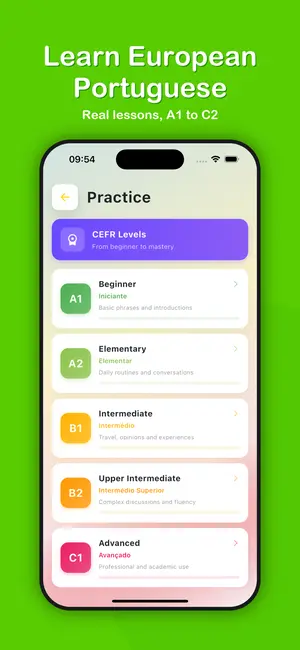
Reading a list is a start, but travel phrases stick only when you hear them spoken by natives and say them out loud. That is where an app built for the Portugal variety helps. Portugal Lifestyle Pro teaches these exact everyday phrases with European pronunciation, so you learn the closed vowels and the sh sounds the right way from the beginning, instead of guessing from spelling. It is designed for travellers and new residents who want to sound natural in Portugal, not Brazil. Have a look at how it works on our Portugal Lifestyle Pro page.
Download Portugal Lifestyle Pro Free →
One Last Tip
You will get the sounds wrong at first, and that is completely fine. What matters is the attempt. Lead with "bom dia," add a "por favor," and finish with "obrigado," and you will find Portugal opens up to you in a way it never does for the traveller who only points and speaks English. Boa viagem.
Written by PG App Studios
An independent app studio in the Algarve run by Pedro Gregório. We write about the problems our apps solve, from learning European Portuguese to raising a toddler.