
On this page
Ask anyone learning European Portuguese what surprised them most and they will say the same thing: it does not sound like it is spelled. Words look one way on paper and arrive at your ears completely transformed. This is why beginners who trained on Brazilian audio, or on nothing at all, feel lost in Lisbon. The good news is that the pronunciation follows rules. Learn them early and everything else gets easier. Here is your beginner's map.
Why It Sounds So Different
European Portuguese is a stress-timed language that compresses hard. It leans on the stressed syllable and squeezes everything around it, dropping or reducing the rest. Brazilian Portuguese, by contrast, gives vowels more room and sounds more open and musical. That compression is why European Portuguese can sound fast, clipped, and consonant-heavy to a newcomer. Once you expect the compression, you stop fighting it.
Closed and Reduced Vowels
This is the heart of the European accent, and the biggest adjustment for beginners.
- Unstressed vowels shrink. An unstressed e often nearly disappears or turns into a faint sound like the e in the English word "the." So "pequeno" is not pronounced pe-KWE-no with full vowels but more like p'QUE-n', with the weak vowels barely there.
- The unstressed a softens. It reduces to a quieter, more neutral sound rather than a full open "ah."
- The unstressed o becomes oo. A final o is usually pronounced like the oo in "book." So "obrigado" ends in an "oo," not an "oh."
The practical takeaway: do not give every written vowel its full value. Hit the stressed syllable and let the rest fade. Beginners who pronounce every letter clearly actually sound less natural, not more.
The Famous Sh Sound
One of the most recognizable features of European Portuguese is the sh sound.
- Final s becomes sh. At the end of a word, s is pronounced like the English sh. "Portugues" ends in a sh, and "as casas" sounds like "ash cazash."
- S before a consonant also becomes sh. In "esquerda" the s turns to sh, giving roughly "shkerda." In "estou" you get "shtou."
- But s between vowels is a z sound. "Casa" is pronounced "caza," not "cassa."
This single feature does more than any other to make you sound Portuguese rather than Brazilian. Practice it deliberately.
Nasal Sounds
Portuguese nasals give beginners trouble because English does not really have them.
- The ao ending. Words like "pao" (bread), "nao" (no), and "irmao" (brother) end in a nasal diphthong. The trick is to let the sound resonate through your nose while gliding from an "a" toward a "w" shape, without ever fully closing your mouth on an n.
- Nasal vowels with m and n. When a vowel is followed by m or n at the end of a syllable, the vowel goes nasal and the consonant mostly vanishes. "Bem" is not "bem" with a hard m but a nasal "being" sound cut short. "Um" hums through the nose.
- The oe and ae nasals. Plurals like "pes" and words like "maes" carry nasal glides too.
The best way in is to stop thinking of m and n as consonants to pronounce and start thinking of them as instructions to send the vowel through your nose.
Letters That Trip People Up
A few specific letters catch beginners repeatedly.
| Letter or combo | Sound in European Portuguese | Example |
|---|---|---|
| lh | like the lli in million | "filho" (son) |
| nh | like the ny in canyon | "vinho" (wine) |
| ch | a soft sh sound | "chave" (key) |
| r at start or rr | a strong throaty r | "carro" (car) |
| single r between vowels | a soft tapped r | "caro" (expensive) |
| c before e or i | an s sound | "cidade" (city) |
| z at end of word | a sh sound | "faz" |
The two r sounds are worth special attention. A single r between vowels is a quick tap, while a double rr or an r at the start of a word is a strong sound made in the back of the throat, closer to a French r for many speakers.
Practice Tips That Actually Work
Knowing the rules is not the same as producing the sounds. Here is how to build the muscle.
- Shadow native audio. Play a short clip, pause, and immediately repeat it, copying the rhythm and the fades, not just the words. This trains your mouth and ear together.
- Record yourself. Say a sentence, play it back, and compare it to the native version. You will hear the gap you cannot feel while speaking.
- Exaggerate the sh and the reductions. Overdo them in practice. When you relax into normal speech you will land closer to natural.
- Learn sounds before spelling. Get the pronunciation of a word into your ear before you fix its spelling in your mind, so the letters do not mislead you.
- Practice a little every day. Pronunciation is physical. Ten minutes daily beats an hour once a week, because your mouth is building habits.
Learn the Sounds the Right Way
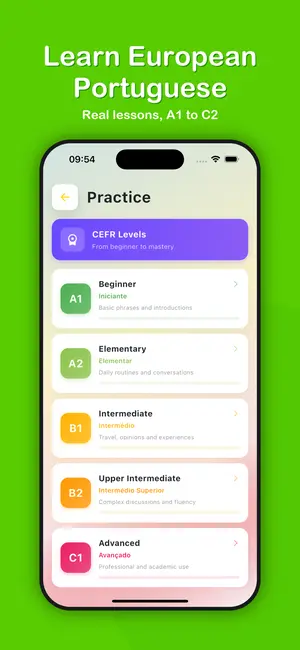
Pronunciation is exactly where a Portugal-specific tool pays off, because guessing sounds from spelling leads you astray. Portugal Lifestyle Pro teaches European Portuguese with native audio, so you hear the closed vowels, the sh endings, and the nasal ao the way they are actually spoken in Portugal, not the more open Brazilian versions. For a beginner, hearing the real thing repeatedly is what makes the sounds stick. See how the lessons are built on our Portugal Lifestyle Pro page.
Download Portugal Lifestyle Pro Free →
Be Patient With Your Mouth
European Portuguese pronunciation feels impossible for about the first month, and then something clicks. Your ear adjusts, your mouth finds the shapes, and the sh sounds and closed vowels stop feeling foreign. Do not aim for a perfect accent on day one. Aim for a little better each week, and let the daily practice do its quiet work.
Written by PG App Studios
An independent app studio in the Algarve run by Pedro Gregório. We write about the problems our apps solve, from learning European Portuguese to raising a toddler.