
On this page
If you are on the path to Portuguese citizenship, you will almost certainly need to prove your Portuguese at the A2 level, and for most people that means the CIPLE exam. It sounds intimidating, but A2 is an achievable level, and the exam is predictable once you understand its shape. This guide walks you through what the test is, how it is structured, and how to prepare without panic.
One important note up front: immigration and citizenship requirements change, and details can be updated. Treat this as general guidance and always confirm the current rules, exam format, and accepted certificates with official Portuguese sources before you rely on anything here.
What Is CIPLE and the A2 Level
CIPLE stands for the Initial Certificate of Portuguese as a Foreign Language. It is the exam that certifies your Portuguese at the A2 level of the Common European Framework, and A2 is the language requirement most applicants use to satisfy the citizenship language condition.
A2 is described as elementary, and that framing is honest. It does not ask you to debate or write essays. It asks you to:
- Understand and use everyday expressions and very common phrases.
- Handle simple, routine exchanges about familiar things like family, shopping, and immediate surroundings.
- Describe in simple terms your background and immediate needs.
This is a reachable target for a motivated adult in several months of steady study. It is not fluency, and you should not intimidate yourself by aiming higher than the exam requires.
How the Exam Is Structured
CIPLE is built around the four language skills, usually grouped into components. The exact weighting and timing can change, so verify current details, but the shape is generally as follows.
| Component | What it tests | Rough form |
|---|---|---|
| Reading comprehension | Understanding short texts | Signs, notices, short passages with questions |
| Writing production | Producing simple written Portuguese | Filling forms, short messages, simple texts |
| Listening comprehension | Understanding spoken Portuguese | Short audio clips with questions |
| Speaking | Interacting and speaking aloud | A short spoken interview with an examiner |
Reading and writing are often assessed together in one paper, and listening and speaking form the oral side. The overall grade combines your performance across these, so a weak spot in one area can be balanced by strength in another. You do not need to be perfect anywhere.
What Each Section Really Asks
Reading
You will face short, practical texts. Think signs, adverts, simple notices, and brief passages, followed by comprehension questions. The vocabulary is everyday, so broad familiarity matters more than depth.
Writing
The writing is simple and functional. Expect to complete a form with personal details and write short messages or notes. Nobody is asking for elegant prose. Clear, correct, simple sentences win.
Listening
You will hear short audio in European Portuguese and answer questions about it. This is where people trained on Brazilian material struggle, because the accent, the reduced vowels, and the sh sounds are different. Practicing with European audio is essential here.
Speaking
The oral is a short conversation with an examiner. You will introduce yourself, answer simple questions about your life, and perhaps describe a picture or situation. Being able to speak calmly and simply beats trying to impress with complex sentences you might stumble over.
A Realistic Preparation Plan
Here is a sensible way to approach it if you are starting from a low level.
- Build a European Portuguese base first. Get comfortable with everyday vocabulary, the present tense, simple past, and the near future. Make sure it is the Portugal variety, since the exam is European Portuguese.
- Train listening deliberately. This is the section that surprises people. Listen to European Portuguese daily, even passively, so the accent stops being a wall.
- Practice speaking out loud. Describe your day, your family, your routine in simple Portuguese. The oral rewards fluency of simple speech, not vocabulary size.
- Drill the exam format. Once your base is solid, work through practice materials that mirror the CIPLE structure so nothing on exam day is a surprise.
- Rehearse the predictable questions. You will be asked your name, where you live, your job, your family, your hobbies. Prepare and polish these answers until they are automatic.
A Realistic Timeline
For a complete beginner studying thirty to forty five minutes a day, plan on roughly six to nine months to reach a comfortable A2. If you already have some Portuguese, three to five months of focused preparation is reasonable. The people who struggle are usually those who cram grammar but never train their ear or their mouth, so protect time for listening and speaking throughout, not just at the end.
Where an App Helps
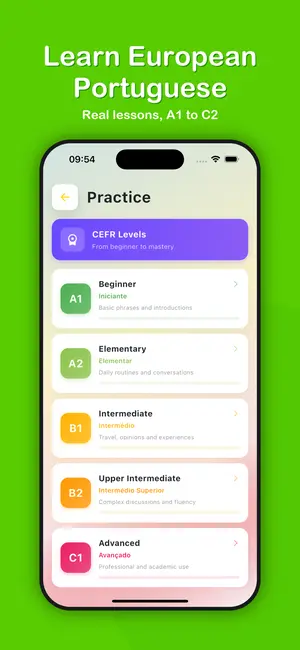
Consistent daily practice in the right variety is the whole battle, and that is where Portugal Lifestyle Pro fits. It teaches European Portuguese specifically, the exact variety the CIPLE exam uses, with native audio for the listening challenge and everyday vocabulary that maps closely to what A2 asks of you. For anyone preparing for citizenship, learning from Portugal-based material rather than Brazilian content removes a real handicap on the listening and speaking sections. You can see how the lessons are organized on our Portugal Lifestyle Pro page.
Download Portugal Lifestyle Pro Free →
Final Word
A2 is a genuinely achievable level, and CIPLE is a fair, predictable exam once you know its shape. Build a European Portuguese base, train your listening hard, rehearse the speaking questions, and practice the exam format before the day. Do that consistently and you will walk in prepared. Just remember to confirm the current requirements, exam structure, and accepted certificates with official Portuguese sources, because the rules around citizenship can and do change.
Written by PG App Studios
An independent app studio in the Algarve run by Pedro Gregório. We write about the problems our apps solve, from learning European Portuguese to raising a toddler.