On this page
You can finish an entire textbook and still feel lost the moment you sit down at a café in Lisbon. That is because textbooks teach you the polite, careful version of a language — and nobody actually talks like that. Real European Portuguese is full of slang, filler words, and shortcuts that make conversation flow. Learn a handful of them and you go from "foreigner reading a phrasebook" to "person who actually gets it."
Here are the slang words and expressions you will hear every single day in Portugal, what they really mean, and how to use them without sounding forced.
Fixe — the word you'll use constantly
Fixe (pronounced roughly "feesh") means cool, nice, or great. It is probably the most useful slang word in the whole language because you can drop it into almost any conversation.
- "O filme foi mesmo fixe." — The film was really cool.
- "Ele é um gajo fixe." — He's a nice guy.
- "Fixe!" on its own works as a reply, like saying "Cool!" or "Nice!"
One important note: this is European Portuguese slang. In Brazil they say legal for the same idea. If you use fixe, you immediately signal that you are learning the European variety — which matters a lot if you are settling in Portugal.
Giro / gira — cute, pretty, lovely
Giro (masculine) and gira (feminine) mean cute, pretty, or charming. It applies to people, objects, places, almost anything pleasant.
- "Que casa gira!" — What a lovely house!
- "Ela é muito gira." — She's really pretty.
- "Um café giro ali na esquina." — A cute little café on the corner.
It is gentle and friendly, never crude. You can safely use it about a shop, a dog, a baby, or a neighbourhood.
Bué — a lot, very, loads
Bué means a lot or very. It came into Portuguese from Angolan Portuguese and is now everywhere, especially among younger people.
- "Está bué calor." — It's really hot.
- "Gosto bué disto." — I like this a lot.
- "Havia bué de gente." — There were loads of people.
You will hear "bué de" before a noun and just "bué" before an adjective. It is casual, so use it with friends rather than in a formal email.
Pá — the all-purpose filler
Pá is the Portuguese equivalent of "man," "dude," or "you know." It softens sentences and buys you a second to think.
- "Pá, não sei bem." — Man, I'm not really sure.
- "É assim, pá..." — It's like this, you know...
Sprinkling a "pá" into your speech instantly makes you sound more natural. Do not overdo it, but one every few sentences is exactly how locals talk.
Ya — casual yes
Ya (borrowed sound-wise from English) is a relaxed way of saying yes or "yeah." You will hear it constantly in informal chat.
- "Vais ao jantar?" "Ya, claro." — Are you going to dinner? Yeah, of course.
It is very informal. In a shop or with officials, stick to sim.
Tá-se bem — all good
Tá-se bem (a shortening of "está-se bem") means "it's all good" or "we're doing fine." It is a laid-back, reassuring phrase.
- "Como está a correr?" "Tá-se bem." — How's it going? All good.
You might also hear just tá as a quick "okay" — the Portuguese swallow the "es" of está constantly.
Gajo / gaja — guy / woman
Gajo means guy or bloke, and gaja means woman or girl. These are informal and mostly neutral among friends, though tone matters.
- "Aquele gajo trabalha comigo." — That guy works with me.
- "A gaja é simpática." — She's nice.
Careful: depending on tone and context, gaja can sound dismissive when talking about a woman you do not know, so use it lightly and read the room. Among friends it is completely normal.
A few more you'll hear fast
| Slang | Meaning | Example |
|---|---|---|
| Chato | Annoying / boring | "Que filme chato." — What a boring film. |
| Fixe/porreiro | Cool (porreiro is a bit older) | "Foi porreiro." — It was cool. |
| Curtir | To enjoy / hang out | "Curti muito a festa." — I really enjoyed the party. |
| Bora | Let's go (from "embora") | "Bora!" — Let's go! |
| Chapado | Exhausted / wiped out | "Estou chapado." — I'm wiped out. |
Why slang matters when you move to Portugal
Here is the honest truth: knowing slang will not get you through an AIMA appointment or help you read a rental contract. For that you need solid, structured European Portuguese. But slang is what earns you warmth in daily life — the small talk with your neighbour, the joke with the guy at the padaria, the sense that you belong rather than visit.
The best approach is to build a strong base of proper European Portuguese first, then layer slang on top so you know when it is appropriate. That balance — correct grammar for the serious moments, natural slang for the human ones — is exactly what makes integration feel real.
Learning the European variety on purpose
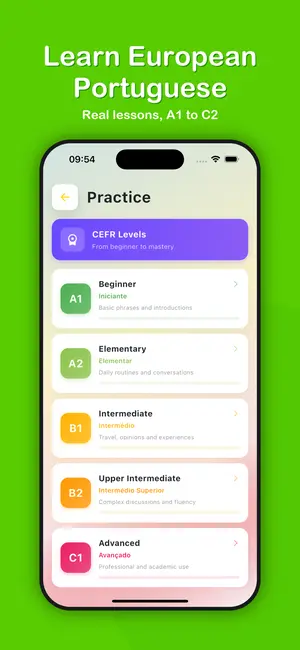
This is where a lot of learners trip up. Most free apps default to Brazilian Portuguese, so you end up learning the wrong pronunciation and vocabulary for where you actually live. Portugal Lifestyle Pro is built specifically around European Portuguese — the accent, the vocabulary, and the everyday expressions people really use in Portugal. It takes you from complete beginner through the A2 level that matters for citizenship, while keeping lessons grounded in real, spoken Portuguese rather than stiff textbook phrases.
If you are moving to Portugal or already here, learning the European variety from day one saves you from unlearning habits later. Slang like fixe and bué is a fun bonus once your foundation is solid.
Practice makes it stick
Do not try to memorise all of these at once. Pick two or three — fixe, pá, and giro are perfect starters — and use them until they feel automatic. Then add more. Within a few weeks you will notice yourself understanding café conversations you would have missed before.
Language is a living thing, and slang is where it lives most. Learn the rules, then learn how people actually break them. That is when Portuguese stops feeling like a subject and starts feeling like home.
Written by PG App Studios
An independent app studio in the Algarve run by Pedro Gregório. We write about the problems our apps solve, from learning European Portuguese to raising a toddler.