On this page
Ask ten anglers what the best tide for fishing is and you will get eleven answers. That is not because nobody knows. It is because the right tide depends on where you stand, what you are chasing and what the water is doing at that exact spot. Once you can read a tide chart, those answers stop contradicting each other.
This guide explains how tides work in plain terms, how to read a tide chart, and how to choose the tide that suits your mark, whether you fish a surf beach in North Carolina, a harbour wall in Cornwall or a rock platform near Sydney.
How tides work, in one minute
The Moon's gravity (and to a lesser extent the Sun's) pulls the ocean into bulges. As the Earth turns under those bulges, most coasts get two high tides and two low tides roughly every 24 hours and 50 minutes, which is why the tide is about 50 minutes later each day.
A few words you will see on every chart:
- Flood (incoming): the tide rising from low to high.
- Ebb (outgoing): the tide falling from high to low.
- Slack water: the short pause around high or low when the current nearly stops.
- Tidal range: the height difference between high and low water.
- Spring tides: the bigger ranges around new and full moon, when Sun and Moon pull in line. Nothing to do with the season.
- Neap tides: the smaller ranges around the quarter moons.
How to read a tide chart
A tide chart (or tide table) gives you, for one location and one day:
- The times of high and low water.
- The predicted height of each, measured from a local reference level called chart datum.
- Often a curve joining them, so you can see how fast the water is moving at any moment.
The curve matters more than most people realise. Water does not rise at a steady rate. On a typical tide it moves slowly in the first hour, fastest in the middle two hours and slowly again in the last. Sailors use the "rule of twelfths" to estimate this: roughly 1/12 of the range in the first hour, 2/12 in the second, 3/12 in the third and fourth, 2/12 in the fifth and 1/12 in the sixth.
For fishing, that middle section is where the current is strongest, and current is what moves bait, stirs up food and switches fish on.
A tide chart tells you when the water moves. Your mark tells you whether moving water is good there.
Use the right station
Tide times can differ by an hour or more between two places only a few miles apart, especially inside estuaries and bays. Always use the station closest to where you actually fish, not the nearest big port.
Incoming or outgoing: which is better?
There is no universal winner, but there are reliable patterns.
The flood (incoming tide) is often best from beaches, rocks and flats. Rising water pushes onto ground that was dry a few hours earlier, full of crabs, worms and shellfish. Fish follow it in to feed. Many shore anglers rate the last two hours of the flood and the first hour of the ebb as the prime window.
The ebb (outgoing tide) often shines in estuaries, creeks and river mouths. Falling water drains bait out of marshes and channels, and predators wait at the mouths and drop-offs for it to come to them.
Slack water is usually the quietest time, with one exception: some deep or fast-flowing marks are only fishable at slack, because the current is too strong to hold bottom the rest of the time.
Spring tides or neap tides?
Spring tides mean bigger ranges and stronger currents. That usually means more feeding activity, more coloured water and more food moving, which suits most saltwater species. The catch is that strong flow can make it hard to hold bottom, and some marks become dangerous on a big spring.
Neap tides are gentler. Weaker flow can mean fewer fish on the move, but neaps can be ideal for marks that are unfishable in heavy current, for light tackle and for clear-water species that spook easily.
A good rule: look at the size of the tide first, then decide where to fish, rather than going to the same spot whatever the range.
Where solunar times fit in
Solunar theory suggests fish feed more actively at certain times linked to the Moon's position: major periods when the Moon is overhead or underfoot, and minor periods around moonrise and moonset. Dawn and dusk add their own boost from changing light.
The evidence is mixed, and the tide will usually matter more. But when a strong part of the tide overlaps a solunar period and a change of light, many anglers treat it as the best window of the day. That overlap is worth planning around.
A simple planning routine
- Check the tide size for the day: spring, neap or in between.
- Pick a mark that suits it. Strong flow for sheltered beaches and estuary mouths, gentle flow for rocks and fast channels.
- Find the moving water on the curve, usually the middle hours of the flood or ebb.
- Look for overlaps with dawn, dusk or a solunar period.
- Log what happens. Note the tide state, height, time and bait every time you catch. After a season you will know your own marks better than any chart.
Plan it in one app, even with no signal
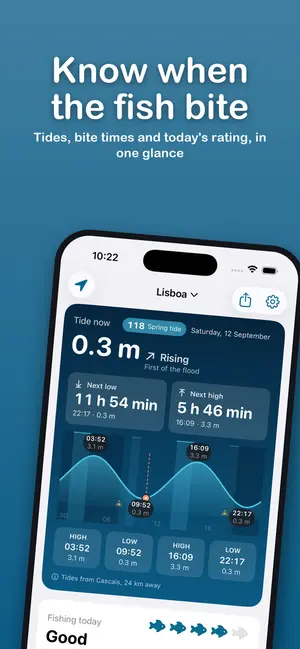
That routine is exactly what TideHook is built for. It computes real harmonic tide predictions on your phone from 3,996 stations, the same method used for official tide tables, so it still works at the end of a coastal track with no bars. You get the full curve for the week, the state of the tide in angler's words (mid flood, top of the tide), solunar bite windows, a bait and rig guide for 85 species, and a catch log that shows you the conditions you actually catch in.
Long-press anywhere on the map for tides at your own mark. TideHook is free to download with a free trial, then a subscription or a one-off lifetime unlock.
Get TideHook on the App Store →
Safety first
Tides catch out experienced anglers every year. Check the times before you walk out onto sand, mud or rocks, know your way back, and keep watching the water. A tide app is a planning tool, never a navigation aid. If you are fishing from a boat, use official charts and local notices.
FAQ
What is the best tide for fishing?
For most shore marks, the moving water of the flood tide, especially the last two hours before high water and the first hour of the ebb. In estuaries and river mouths, the ebb is often better because it carries bait out to waiting fish.
Is it better to fish on an incoming or outgoing tide?
It depends on the mark. Incoming tides suit beaches, rocks and flats where fish move in to feed on newly covered ground. Outgoing tides suit estuaries, creeks and channel mouths where draining water concentrates bait.
Are spring tides good for fishing?
Usually yes, because stronger currents move more food and trigger feeding. They can make holding bottom harder and some marks unsafe, so neap tides can be better for light tackle and fast-flowing spots.
Do solunar times really work?
The evidence is mixed. Tide and light usually matter more, but many anglers find the best sessions come when a moving tide overlaps dawn, dusk or a solunar major period.
How far apart can tide times be?
Even a few miles can change high water by an hour or more, especially inside bays and estuaries. Always use the tide station closest to your mark.
Keep reading
If you fish to stay active, our guide to walking for weight loss pairs well with long days on the coast. Browse all our guides on the blog.
Written by PG App Studios
An independent app studio in the Algarve run by Pedro Gregório. We write about the problems our apps solve, from learning European Portuguese to raising a toddler.