
On this page
A great photo or video gets the scroll to pause. The caption decides whether someone stays, engages, and follows. Yet captions are the part most creators rush or skip. The good news is that writing better captions is a learnable skill, and AI can now take most of the friction out of it. Here is how to do both.
What Makes a Good Caption
Every strong caption does at least one of three jobs: it hooks attention, adds context the visual cannot, or invites a response. The best ones do all three. A caption is not a description of what people can already see. It is the voice that gives your content meaning.
Three ingredients matter most:
- A hook in the first line that earns the tap on "more".
- Value or story in the middle that rewards the reader for staying.
- A call to action at the end that tells people what to do next.
Miss the hook and nobody reads the rest. Miss the call to action and engaged readers scroll away without acting.
Captions Change by Platform
The same idea should be dressed differently depending on where it lives. Treating every platform the same is the most common caption mistake.
Instagram rewards storytelling and personality. You have room to breathe, so use the first line as a hook and let the rest build a small narrative or share a genuine insight. Line breaks make longer captions readable. End with a question or a clear prompt to comment, save, or share.
TikTok
On TikTok the caption is short and works with the video, not instead of it. Its main job is to add context, tease the payoff, or pose a question that makes people watch again. Keep it punchy. A single curious line often outperforms a paragraph.
X (Twitter)
X rewards brevity and a strong point of view. One sharp sentence beats three soft ones. Lead with the most interesting thing you have to say, cut every unnecessary word, and let the idea do the work. Threads can expand a topic, but the first post has to stand alone.
LinkedIn favours professional value and reflection. Start with a relatable hook, share a lesson or observation, and keep the tone human rather than corporate. Short paragraphs and a clear takeaway perform well. End by inviting others to share their own experience.
Writing Better Hooks
The hook is the highest-leverage part of any caption. A few reliable patterns:
- The question — pose something your audience genuinely wonders about.
- The bold statement — say something specific and a little contrarian.
- The result — lead with the outcome, then explain how you got there.
- The mistake — name a common error people make, then correct it.
Avoid vague openers like "Excited to share" or "Check this out". They tell the reader nothing and waste your most valuable line.
Match the Length to the Goal
Length is a tool, not a rule. A short caption creates intrigue and works well when the visual carries the message. A longer caption builds connection and works well when you have a story or a lesson worth telling. The mistake is defaulting to one length out of habit. Ask what the post is for. If the goal is a quick laugh or a bold statement, keep it tight. If the goal is to build trust and depth over time, give the reader something substantial to sink into. Varying your length also keeps a feed from feeling repetitive, which quietly holds attention across your whole profile.
Write for One Person
The captions that connect rarely try to speak to everyone. They speak to one specific person as if in a direct message. When you picture a single reader, someone who follows you and cares about your topic, your tone naturally warms up and your language sharpens. Broad, generic copy that tries to please everyone ends up moving no one. Narrow your imagined audience and, paradoxically, more people relate.
Hashtags Without the Guesswork
Hashtags help discovery, but more is not better. A handful of relevant, specific tags beats a wall of generic ones. Mix a few broad tags with several niche ones that describe exactly what your content is about. On Instagram and TikTok they aid reach. On X and LinkedIn keep them minimal, since a couple of well-chosen tags look cleaner and perform better than a cluttered list.
A Simple Caption Framework
When you are stuck, fall back on this three-part structure:
- Hook — one line that stops the scroll.
- Body — the story, value, or context that keeps them reading.
- Call to action — the single thing you want them to do.
Write the hook last if it helps. Often you discover your best opening line buried in the middle of your first draft.
Where AI Speeds Everything Up
Here is the honest truth about captions: the writing is not hard, the starting is. Staring at a blank field kills momentum, especially when you are posting daily across several platforms.
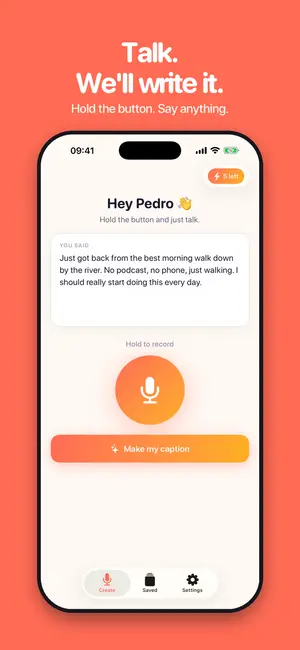
This is where an AI voice-to-caption tool changes the game. The average person speaks around three times faster than they type, and speaking captures your natural enthusiasm in a way typing rarely does. Instead of wrestling with a blank box, you simply talk through your idea and let AI shape it into a polished caption.
Voice To Caption: AI Writer does exactly this. You speak your thoughts, and the app transcribes and crafts a clean, ready-to-post caption, adapts the tone to the platform you are posting on, and adds relevant hashtags automatically. What used to take ten minutes of second-guessing becomes about thirty seconds of talking. You still bring the ideas and the personality. The app removes the friction of turning them into words.
Download Voice To Caption Free →
See how it works on the Voice To Caption page.
Edit Like a Human
Whether AI helps or not, always read your caption aloud before posting. Does the first line make you want to keep reading? Is there a word you would never actually say in conversation? Is the call to action clear? Trim anything that sounds stiff. The goal is copy that sounds like you on your best, most articulate day.
The Takeaway
Better captions come from a repeatable process, not luck. Lead with a real hook, tailor the message to the platform, keep hashtags relevant, and always tell people what to do next. Then let AI carry the heavy lifting of turning your spoken ideas into polished text, so you can post more consistently without burning out. Say it, shape it, ship it.
Written by PG App Studios
An independent app studio in the Algarve run by Pedro Gregório. We write about the problems our apps solve, from learning European Portuguese to raising a toddler.