
On this page
Every year more Americans trade the US for Portugal — for the pace of life, the safety, the weather, the healthcare, and a cost of living that (in many places) still beats a US metro. If you are seriously considering the move in 2026, this guide walks you through the big picture: why people do it, the main visa routes, the paperwork order, and a realistic timeline.
A quick but important note: immigration rules change often, and the details below are general. Always verify the current requirements with official sources such as AIMA (Portugal's immigration agency) and a Portuguese consulate before making decisions. Nothing here is legal advice.
Why Americans move to Portugal
The reasons repeat again and again:
- Safety. Portugal consistently ranks among the safest countries in the world.
- Cost of living. Outside central Lisbon and Porto, your money often stretches further than in a major US city — though the gap has narrowed in recent years.
- Healthcare. Portugal has a public health system, and private care is comparatively affordable.
- Lifestyle. Walkable towns, great food, mild weather, and a slower rhythm.
- EU access. Residency in Portugal opens up travel across the Schengen area.
It is not paradise — bureaucracy is slow, and learning the language takes real effort — but for many people the trade is worth it.
The main visa routes
For Americans planning to live in Portugal long-term, two residency visas come up most often.
D7 Visa — passive income / retirement
The D7 is designed for people who can support themselves with stable, passive income: pensions, rental income, dividends, or similar. It is popular with retirees and anyone with reliable non-employment income. You generally need to show income roughly at or above the Portuguese minimum wage level, plus more for dependents — but verify current amounts, because these thresholds are updated.
D8 Visa — digital nomad / remote work
The D8 (the digital nomad visa) suits people who work remotely for companies or clients outside Portugal. It typically requires a higher monthly income than the D7 — often stated as around four times the Portuguese minimum wage — again, confirm the exact figure at application time.
We have a dedicated comparison if you want to go deeper on choosing between them.
The paperwork, roughly in order
The exact sequence varies, but this is the general flow most people follow.
1. Get your NIF
The NIF (Número de Identificação Fiscal) is your Portuguese tax number, and almost nothing happens without it. You need it to open a bank account, sign a lease, and set up utilities. You can get one in person at Finanças, or through a lawyer or fiscal representative before you even arrive.
2. Open a Portuguese bank account
With a NIF you can open a local account, which you will use to show funds and pay for things once you are settled. Some banks let you start the process remotely.
3. Sort out housing
For most visa applications you need proof of accommodation in Portugal — a rental contract or property purchase. Many people rent for the first year before buying, so they can learn the neighbourhoods first.
4. Apply for the visa at a consulate
You apply for the D7 or D8 at a Portuguese consulate covering your US region, with your income proof, background check, accommodation, health insurance, and other documents. This gets you an entry visa.
5. Attend your AIMA appointment
Once in Portugal, you complete the process with AIMA (which replaced the old SEF) to receive your residence permit. Backlogs have been a real issue here, so patience and well-organised documents matter.
6. Register for healthcare and other essentials
After you have residency, you can register with the public health system, get your utility accounts in your name, and settle in properly.
A realistic timeline
| Stage | Rough timing |
|---|---|
| Gathering documents (NIF, income proof, background check) | 1–3 months |
| Consulate visa processing | 2–4 months (varies a lot) |
| Arrival + AIMA appointment | Weeks to many months, depending on backlog |
| Full settling in | 6–12 months total is common |
Do not expect it to be fast. Build in buffer time and keep copies of everything.
The language piece — don't skip it
You can technically get by in English in tourist-heavy areas, but real life in Portugal happens in Portuguese: the AIMA counter, the health centre, your lease, your neighbours, the tax office. And if you plan to pursue citizenship down the line, you will need to demonstrate Portuguese at the A2 level — a basic but real proficiency standard.
Starting the language before you move gives you a huge head start. The catch is that you specifically need European Portuguese, not the Brazilian variety most apps default to — different accent, different vocabulary, different verb usage.
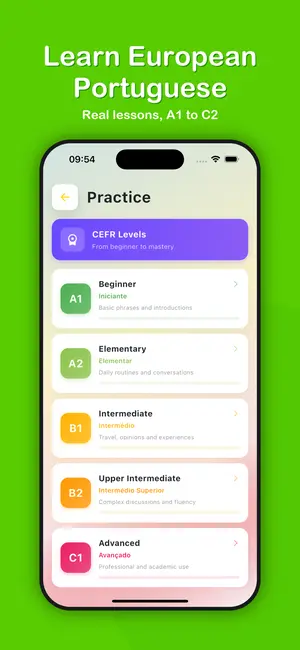
That is exactly what Portugal Lifestyle Pro focuses on. It teaches European Portuguese from beginner up through the A2 level relevant to citizenship, with the everyday phrases you will actually use at Finanças, at the health centre, and in your neighbourhood. Learning even the basics before your first AIMA appointment makes the whole experience less intimidating.
Download Portugal Lifestyle Pro Free →
Final advice
Three things separate the smooth moves from the stressful ones:
- Start early. Documents and appointments take longer than you think.
- Get local help for the paperwork. A good immigration lawyer or relocation service is worth it for the D7/D8 process.
- Learn the language. It is the difference between surviving in Portugal and actually living there.
Portugal rewards people who show up prepared and patient. Get your documents in order, verify every rule against official sources, start learning Portuguese now, and the move becomes a lot less daunting than it looks from across the Atlantic.
Planning from somewhere else? See our guides for moving from the UK, Germany and Australia, or start at our Moving to Portugal hub.
Written by PG App Studios
An independent app studio in the Algarve run by Pedro Gregório. We write about the problems our apps solve, from learning European Portuguese to raising a toddler.