
On this page
If you are moving to Portugal, one acronym will dominate your paperwork life: AIMA. It is the agency that decides whether you get your residence permit — and, thanks to a major backlog, it is also the part of the process people find most stressful. Understanding what AIMA is, what its appointments are for, and how to prepare can make a genuinely frustrating experience far more manageable.
One important note up front: immigration processes in Portugal change frequently, and the situation with AIMA in particular has been evolving. Treat this as a general guide and always verify the current process through official AIMA channels. This is not legal advice.
What is AIMA?
AIMA stands for Agência para a Integração, Migrações e Asilo — the Agency for Integration, Migration and Asylum. It was created to replace the former immigration authority, SEF (Serviço de Estrangeiros e Fronteiras), which was dissolved.
In practice, AIMA now handles most of what SEF used to do for immigrants: processing residence permits, renewals, family reunification, and integration matters. If you hear long-time expats still saying "SEF," they are referring to the old name for essentially the same function.
What AIMA appointments are for
An AIMA appointment is where the human, in-person part of your residency process happens. Depending on your situation, an appointment might be for:
- Finalising a residence permit after arriving on a visa (like the D7 or D8)
- Renewing an existing residence permit
- Family reunification — bringing a spouse or children
- Biometrics — fingerprints and photo for your permit card
- Submitting or verifying documents connected to your application
The appointment is typically where they check your documents, take biometrics, and move your file toward the issuing of a physical residence card.
The backlog reality
Here is the honest part. When SEF was dissolved and AIMA took over, an enormous backlog of pending cases built up — hundreds of thousands of applications. This has meant:
- Long waits to even get an appointment
- Special task forces and mission structures set up to clear the queue
- Extensions of document validity so people are not left without legal status while they wait
- Frequent changes to how appointments are scheduled and handled
The situation has been improving in phases, but the key expectation to set is patience. Delays are common and largely outside your control. What you can control is being organised, responsive, and ready the moment your appointment comes.
How to prepare your documents
The single best thing you can do is have every document ready, complete, and correctly organised. A missing paper can mean rescheduling — and another long wait. General tips:
- Bring originals and copies. Do not assume they will photocopy for you.
- Keep documents current. Background checks, proof of income, and insurance often have validity windows — make sure nothing has expired.
- Match your visa type. A D7 file and a D8 file need different income evidence; bring what your specific route requires.
- Have your NIF and proof of address ready. These come up constantly.
- Bring proof of accommodation. A rental contract or property documents.
- Print your appointment confirmation. Have the date, time, and reference easily accessible.
- Arrive early. Give yourself buffer time to find the office and check in.
A simple checklist you tick off the night before saves a lot of morning panic.
Key vocabulary you'll hear
Even though some staff speak English, appointments are conducted largely in Portuguese, and understanding the key words reduces stress enormously. A starter list:
| Portuguese | Meaning |
|---|---|
| Autorização de residência | Residence permit |
| Marcação | Appointment |
| Documentos | Documents |
| Comprovativo | Proof / supporting document |
| Morada | Address |
| Renovação | Renewal |
| Reagrupamento familiar | Family reunification |
| Cartão | Card |
| Prazo | Deadline / time limit |
| Assinatura | Signature |
Being able to recognise "comprovativo de morada" (proof of address) or "autorização de residência" when an official says it means you follow the conversation instead of freezing.
Language makes AIMA far less intimidating
The immigration process is stressful enough without a language barrier on top. Understanding the vocabulary, following what the official is asking, and being able to respond even simply changes the whole experience. It also signals that you are serious about integrating — which matters, because Portugal expects new residents to reach the A2 level of Portuguese on the path to citizenship.
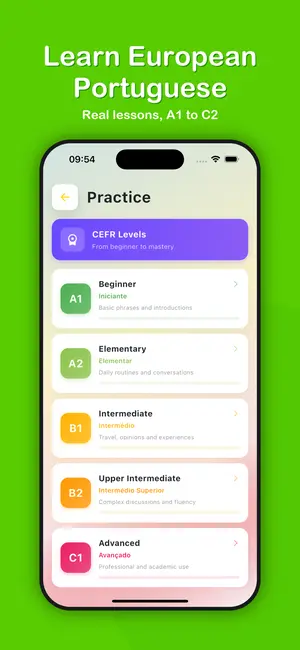
The catch, as always, is that you need European Portuguese — the accent and vocabulary used in Portugal — not the Brazilian variety most apps default to. Portugal Lifestyle Pro is built for exactly this: European Portuguese from beginner through the A2 level, including the practical, bureaucratic vocabulary you will hear at AIMA, Finanças, and the health centre. Even a few weeks of study before your appointment can turn a nerve-wracking morning into a manageable one.
Download Portugal Lifestyle Pro Free →
Final thoughts
AIMA is the gatekeeper of your legal status in Portugal, and yes, the backlog has made it a source of real frustration. But the people who navigate it best are not the lucky ones — they are the prepared ones. Verify the current process through official AIMA channels, keep your documents complete and current, learn the key Portuguese vocabulary, and go in organised and calm. The system is slow, but it does move — and preparation is how you make sure that when your turn comes, you are ready.
Written by PG App Studios
An independent app studio in the Algarve run by Pedro Gregório. We write about the problems our apps solve, from learning European Portuguese to raising a toddler.