On this page
Pickleball looks simple from the sideline, and the good news is that it mostly is. You can be rallying within your first ten minutes. But there are a handful of rules — especially one about a zone called "the kitchen" — that trip up every newcomer. Learn them once and you'll walk onto the court knowing what you're doing. Here's everything a first-timer needs.
What is pickleball, anyway?
Pickleball is a paddle sport that mixes elements of tennis, badminton and table tennis. You play on a court the size of a badminton court, with a net slightly lower than a tennis net, using solid paddles and a light plastic ball with holes in it. You can play singles, but doubles is by far the most common and the most social.
The appeal is that it's easy to start and endlessly deep to master. Grandparents and teenagers can play the same game and both have fun, which is a big reason the sport has grown so fast.
The basic rules
Serving
The serve is underhand and hit diagonally across the court, landing in the opposite service box. Traditionally you contact the ball below your waist. The serving team can only score points, and each side keeps serving until they lose a rally.
The two-bounce rule
This one is essential and unique. After the serve, the ball must bounce once on the receiving side before it's returned, and then bounce once on the serving side before that team can hit it. So the ball bounces twice total before anyone is allowed to hit it out of the air. After those two bounces, volleys (hitting the ball before it bounces) are allowed — except in one special area.
The kitchen (non-volley zone)
The seven-foot zone on each side of the net is officially the non-volley zone, universally nicknamed "the kitchen." You cannot volley — hit the ball out of the air — while standing in the kitchen or touching its line. You can step in to play a ball that has bounced, but you can't be planted there smashing volleys.
This rule is what keeps the game fair and strategic. Without it, tall athletic players would just camp at the net and slam everything. Respect the kitchen and half your beginner faults disappear.
Scoring, made simple
Scoring confuses everyone at first, so take it slowly.
- Games are usually played to 11 points and you must win by 2.
- Only the serving team can score a point.
- In doubles, the score is called as three numbers: your team's score, the other team's score, and the server number (1 or 2).
So you might hear "4 - 2 - 1." That means the serving team has 4, the other team has 2, and it's the first server's turn. Each player on a team gets to serve before the serve passes to the opponents, except for the very first service turn of the game, which starts with only the second server. Don't overthink it early on — your playing partners will call the score for you until it clicks.
The gear you actually need
Pickleball is refreshingly cheap to start. Here's the honest list.
A paddle
Your one real purchase. Beginner paddles are affordable and totally fine to learn on. Look for a mid-weight paddle (around 7.5 to 8.5 ounces) with a comfortable grip. Don't spend a fortune before you know you love the sport — you can upgrade later once you understand what feel you prefer.
Balls
Pickleballs are the light plastic balls with holes. Outdoor balls have smaller, harder holes; indoor balls are softer with larger holes. Grab a few in the right type for where you'll play. They're inexpensive and they do crack over time.
Shoes
This is the one place not to cut corners. Wear proper court shoes — tennis or dedicated pickleball shoes — with good lateral support. Running shoes are built for going forward, not for the quick side-to-side movement pickleball demands, and they're a rolled-ankle waiting to happen.
Comfortable clothes
Whatever you'd wear to the gym. Breathable, easy to move in. That's it. No special outfit required.
| Item | Priority | Rough approach |
|---|---|---|
| Paddle | Essential | Mid-weight beginner model |
| Balls | Essential | Match indoor vs outdoor |
| Court shoes | Highly recommended | Proper lateral support |
| Athletic clothes | Nice to have | Anything comfortable |
Your first few games
Knowing the rules is only half of it. Here's how to make your actual first outing fun instead of intimidating.
- Tell people you're new. The community is famously welcoming and folks will happily coach you between points.
- Let the ball bounce. Beginners rush to volley and forget the two-bounce rule. Patience wins early rallies.
- Stay out of the kitchen when volleying. If in doubt, hang back a step behind the line.
- Aim for consistency, not power. Just getting the ball back over the net wins far more points at the start than trying to smash.
Finding that first game
The last hurdle is simply finding people to play with, and this is where a lot of beginners stall. You don't want to wander to a random court and hope. This is exactly the problem DinkUp solves.
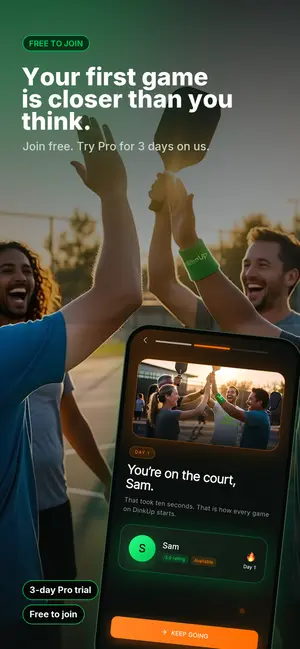
DinkUp shows you pickleball courts near you on a live map, lists open games you can join with a single tap, and lets you see the skill level of a game before you commit — so your very first outing can be with other beginners rather than a group of ringers. You can message players, find beginner-friendly sessions, and build up a regular crew as you improve.
See how it works on the DinkUp page.
The bottom line
Pickleball rewards you almost immediately. Learn the serve, the two-bounce rule, the kitchen and the basics of scoring, grab a cheap paddle and proper shoes, and get yourself into a beginner-friendly game. Within a few sessions the rules will be second nature and you'll be hooked like the rest of us. Welcome to the fastest-growing sport around — go play.
Written by PG App Studios
An independent app studio in the Algarve run by Pedro Gregório. We write about the problems our apps solve, from learning European Portuguese to raising a toddler.